Documented lives,
read as patterns
Six biographies built the hard way round. The map is drawn first, from nothing but a name and a date of birth. Then the life is checked against it, scene by sourced scene — including the scenes that refuse to fit.
The six volumes
Marie Curie
She discovered two elements, won two Nobel Prizes in two different sciences, and refused to patent the process that would have made her wealthy — on the grounds that radium belonged to everyone. She also carried the substance in her pocket, kept her notebooks on her desk, and died of the thing she had spent her life describing.
The book traces the same trait through both halves of that sentence: the refusal to protect herself, which produced the generosity and produced the illness. Same territory, two outcomes.

Nikola Tesla
He built the motor that still turns the modern world, lit the first great electrified city, imagined global wireless communication a century early — and tore up the contract that would have made him the richest man alive. He died alone and broke in room 3327 of a New York hotel, with pigeons.
Bad luck, conspiracy, or the price of genius? The book argues for a fourth answer: one empty territory in the map, and the same emptiness behind the torn contract, the uninsured laboratory, the mortgaged tower at Wardenclyffe and the radio patents recovered only after his death. It is the clearest volume in the series, because the gap between what he could do and what he kept is the widest.
Leonardo da Vinci
Around fifteen finished paintings in a working life of half a century. Thousands of notebook pages, a flying machine, an unbuilt horse, a mural that began deteriorating while he was still alive. Patrons who waited years and got nothing. The most gifted man of his age delivered less than almost any of his contemporaries.
This volume treats the unfinished work as the subject rather than the footnote, and follows the same mechanism from the notebooks to the commissions: the moment a problem was understood, the interest in completing it drained away.
Walt Disney
He lost his first successful character to a distributor, bet the studio on a feature everybody called a folly, and spent the rest of his life building places that could not be taken away from him — a studio, a park, and finally a planned city he did not live to see.
The book reads the whole career as one repeated construction: an unstable childhood address rebuilt, at increasing scale, in materials that could not be repossessed. The strike of 1941 and the men who never forgave him are in here too.
Frida Kahlo
A bus accident at eighteen, some thirty operations, a body held together by corsets — and a body of work that turned all of it into the most recognisable self-portraiture of the century. She painted from a bed and travelled as far as Paris; she left Diego Rivera and married him again.
The tension in the title is the tension in the life: an anchor she never wanted and a flight she never completed. The volume resists the temptation to make the pain into a virtue, and looks at what she built with it instead.
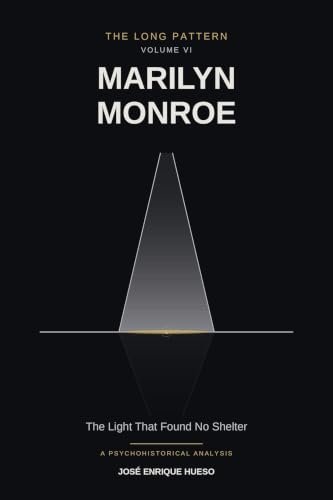
Marilyn Monroe
Eleven foster placements before adulthood. A studio contract she fought to escape, a production company of her own that nobody expected her to found, a reading list that everyone found funny. The most photographed woman in the world, and no address that was reliably hers.
This is the hardest volume to write without cruelty, and the book tries to earn that: it treats her as a professional who understood exactly what she was selling, and looks at what happens to someone whose entire value is placed in being looked at.
Why read a biography this way
Conventional biography answers what happened. It does it well, and these books depend on that work entirely. What it rarely answers is why the same person kept walking into the same wall in four unrelated areas of their life.
A pattern reading is one attempt at that question. It has an obvious weakness and it is stated in every volume: knowing how a life ended makes it easy to build a story that fits. The only defence is to publish the misses alongside the hits, which is why each book contains a section on what the reading gets wrong.
If you want to test the method before buying anything, the analyses on this site are free and use only public data.
Questions
What is a psychohistorical biography?
Are these books biographies or personality analysis?
Do I need to believe in the method to read them?
In what order should I read the series?
Are the books available in Spanish?
Eight axes. One report. Your pattern.
The books apply the method to lives you can verify. The same method, applied to yours, is what OCTANT does.